

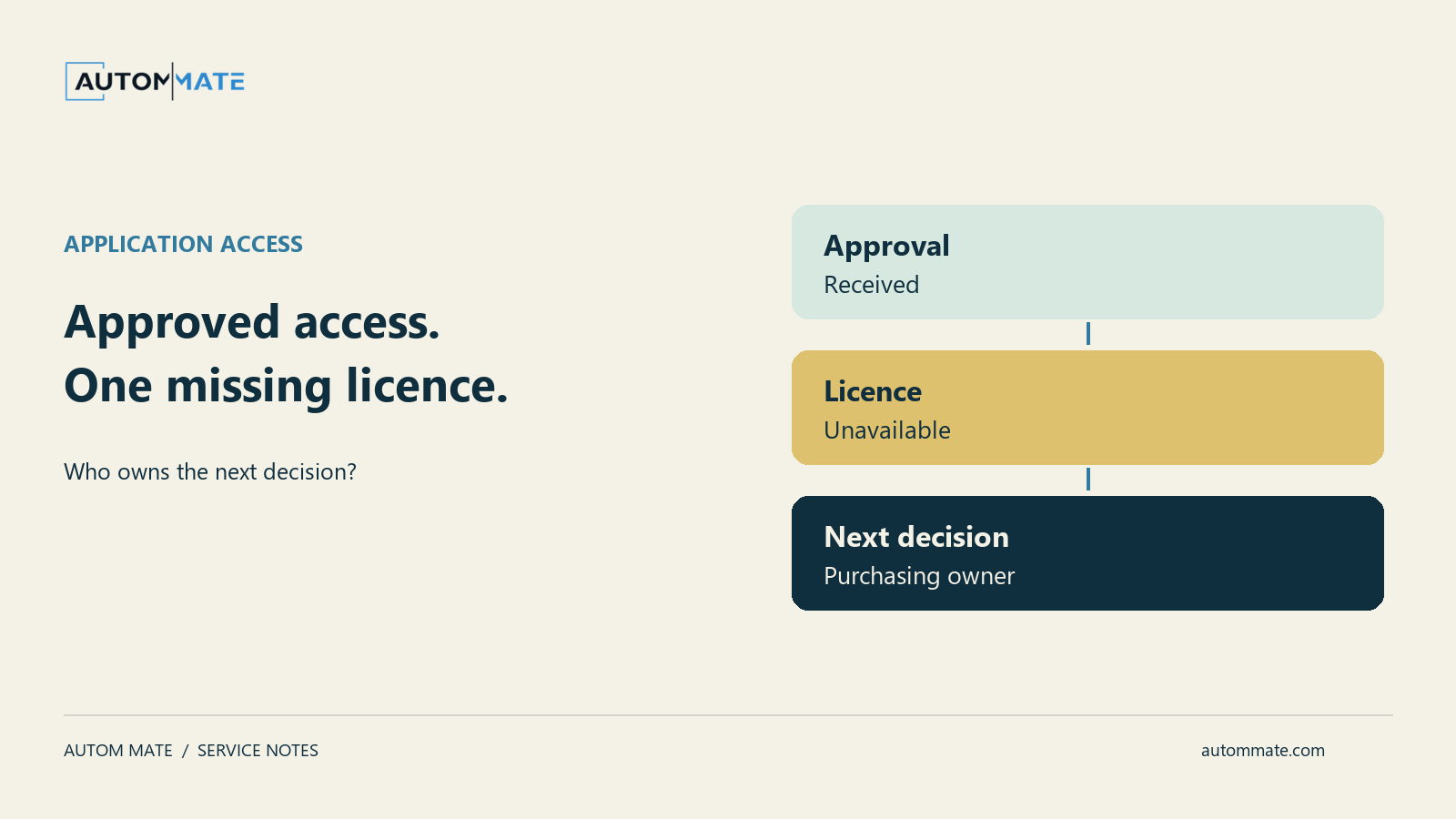
The request looks simple: “Can you give our new account manager access to the CRM?” The account exists. The manager has approved it. Then the technician discovers that the customer has no spare licence.
Someone now has to get a purchasing decision, keep the requester informed and return to the original job. That coordination is part of the work an MSP delivers. It should be visible in the service offer.
Here is a way to package application access as a recurring service. It is an illustrative design to adapt to a customer’s systems, permissions and support agreement.
Make the promise small enough to keep
Start with named applications and ordinary user roles. A useful first description is: “We handle approved user-access requests for your agreed applications, verify the resulting access and keep you informed when a dependency prevents completion.”
That gives sales and service delivery the same boundary. Adding an administrator role, buying a licence or investigating a compromised account can follow a separate approval or service path. These are different decisions, even when they start in the same ticket.
Put the awkward cases in the offer
For each application, agree an owner who can approve access and a backup approver. Record which roles the service covers, the source of employee identity and where completion will be checked.
| Request condition | Service response |
|---|---|
| Identity and approval are valid; a licence is available | Apply the approved access and read it back from the target system. |
| Approval is missing | Ask the named approver. Keep the access change on hold. |
| No licence is available | Ask the customer’s purchasing owner for a decision. Record the next update time. |
| The account already has the requested access | Verify the existing assignment and avoid duplicating it. |
| The target system cannot be reached | Keep the request open with a recovery owner. Confirm the actual state before retrying a write. |
Agree what happens when the customer does not respond. A reminder, escalation and expiry may all be appropriate, but they need a defined owner. Pausing a service-level clock, where the contract permits it, does not remove the need to tell the requester what happens next.
Choose a charging unit the customer can understand
One possible model is a monthly service fee covering a defined set of applications and a stated request allowance. Another is a charge per completed access request. Either can work; the operating record must support the chosen unit.
Specify whether licence procurement, privileged access, after-hours work and application onboarding are included. Also decide how a request that is withdrawn, rejected or already satisfied is treated. A retry should not silently become a second billable request.
Before proposing a price, record the work required for customer setup, normal delivery, exception handling and ongoing maintenance. Include the human work of chasing approvals. Use those observations to set the allowance and support boundary. A catalogue revenue scenario cannot tell you this customer’s cost to serve.
Give the technician a clear finish line
A successful API response is useful evidence, but check the resulting assignment as well. For the relevant application, confirm the account, tenant and role. Where practical, obtain the user’s confirmation that the intended task is now possible.
If the role is present but sign-in still fails, record that distinction. It may need a separate investigation, but closing the access request without explaining the remaining problem creates another conversation for the service desk.
Sell a bounded pilot
Choose one customer, one application and one standard role. Rehearse an approved request, a missing approval, an unavailable licence and an uncertain write result in an authorised test environment. Have another technician follow the exception instructions.
Autom Mate’s Service Catalog includes an “Approved application access” blueprint as a starting point. Configure and validate it for the customer’s environment before making a live delivery commitment.
Take a short service offer to the customer: the applications covered, the outcome, the charging unit and who decides when delivery is blocked. That is enough to have a concrete conversation about a paid pilot.

