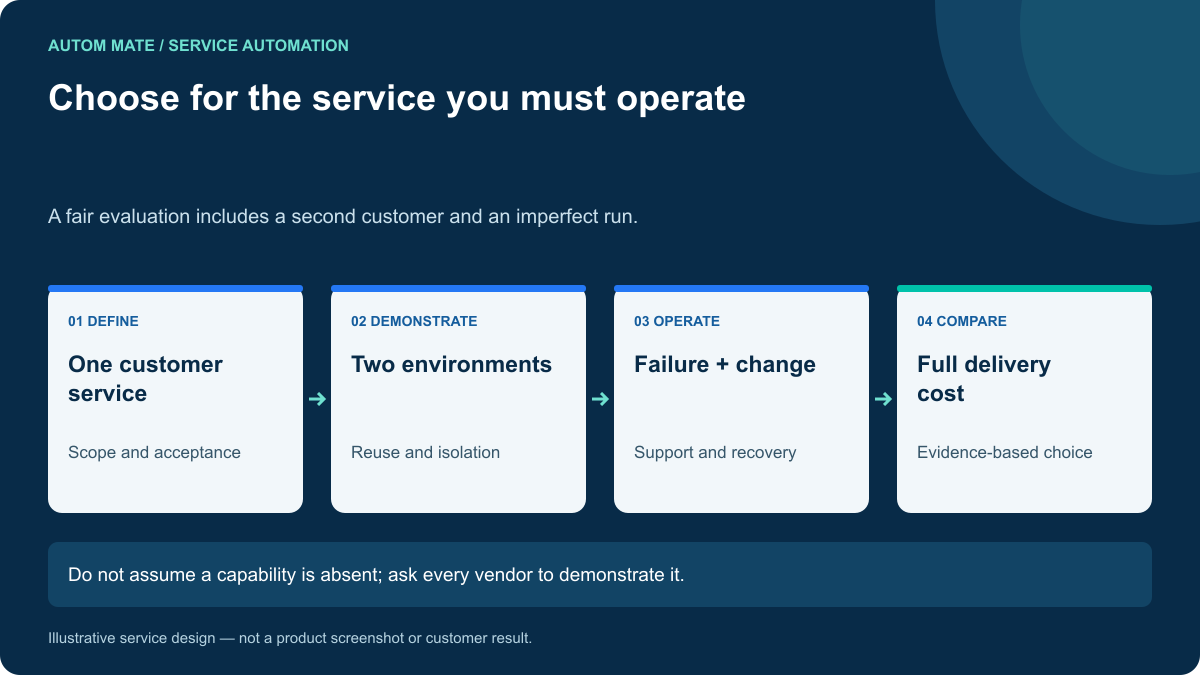

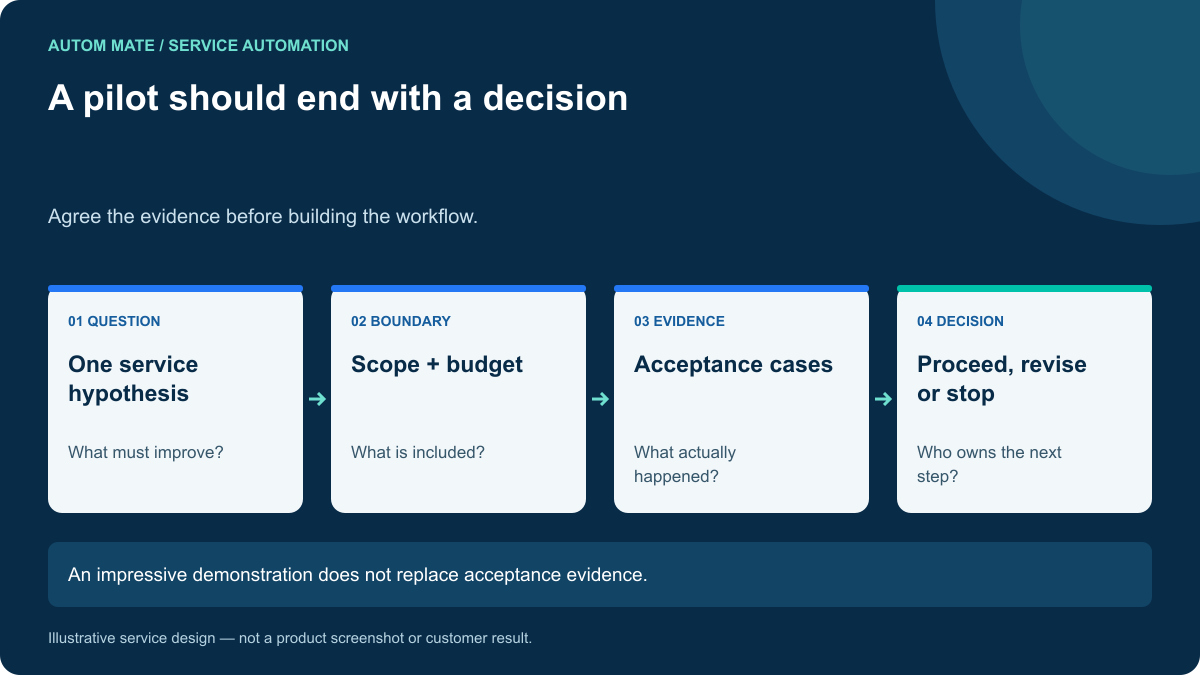
An IT automation proof of concept should answer whether a defined service can be delivered reliably, operated by the responsible team and justified by its expected value. It should end with an explicit decision. “The demo worked” is too small a conclusion for production and too vague a basis for another month of work.
The scorecard below is intended for IT leaders, service owners and MSP teams evaluating a workflow that crosses several systems. Adapt its acceptance requirements to the consequence of the service.
Write the pilot question in one sentence
A useful question might be: “Can approved standard reporting-access requests reach a verified outcome with fewer manual touches while preserving our approval policy?” It names the service, the benefit and a control that must remain intact.
A broad objective such as “prove AI automation” does not tell the team which requests to include or what result would be sufficient. Narrow the scope until the owner can explain both success and a sensible stop decision.
Create a one-page pilot charter
| Item | What to record |
|---|---|
| Service | One request type and its verified outcome. |
| Population | Eligible customers, users, applications and exclusions. |
| Baseline | Request volume, active handling and current failure patterns. |
| Authority | Approvers, permitted actions and test identities. |
| Resources | Time, implementation effort and spending boundary. |
| Acceptance | Required cases, evidence and operating ownership. |
| Decision date | When to continue, redesign or stop the scoped test. |
Do not treat a pilot deadline as a promise that every integration can be delivered within that time. An unavailable API, missing permission or unclear policy is a dependency to resolve, not a reason to bypass a control.
Use gates before a weighted score
Some conditions should prevent production regardless of how much time the workflow saves. Examples include acting in the wrong customer environment, changing access without valid authority or being unable to identify what a failed run already changed.
Record those as mandatory gates. Only compare convenience, efficiency and cost after the relevant gates pass. A weighted average can hide an unacceptable failure if a strong score elsewhere compensates for it numerically.
| Area | Acceptance evidence | Decision if missing |
|---|---|---|
| Identity and scope | Correct target; ambiguous input held. | Resolve before production. |
| Authority | Current approval checked; withdrawn request blocked. | Resolve before production. |
| Outcome | Expected state verified or uncertainty explicitly assigned. | Redesign completion logic. |
| Recovery | An operator recovers the approved failure case. | Complete operating readiness. |
| Value | Observed effort and cost compared with baseline. | Reassess scope and economics. |
Choose cases that distinguish a service from a demo
Include an ordinary request, an already-satisfied request, a duplicate delivery, a changed approval and a target failure. For MSPs, add the same scenario in a second customer environment with different mappings.
Agree how to observe each outcome. A workflow can receive a successful technical response while the user still lacks the requested capability. Use the supported target-state checks and acknowledge where only human confirmation is available.
Capture the input, service version, expected result, observed result and responsible reviewer. The purpose is a compact evidence record another person can inspect, not a large collection of unexplained screenshots.
Separate speed, effort and quality
Measure elapsed fulfillment time, active human handling and exceptions independently. A request can become faster because approvals improve while technician effort remains unchanged. It can require less handling while waiting longer in an external application.
Use the same eligible population for the baseline and pilot comparison. Excluding difficult requests only after automation begins makes the result misleading. If you narrow the scope, state that change and recompute the comparison.
For a small sample, report the observed results without claiming a stable long-term rate. A pilot can prove a behavior and reveal an operating issue even when it cannot support a precise ROI forecast.
End with one of three decisions
- Proceed within the tested scope. Required gates pass, ownership is clear and observed value supports continued operation. Expand only after assessing the next scope.
- Redesign and retest. A specific solvable issue remains. Name the change, owner, evidence needed and bounded retest.
- Stop this scope. The dependency, maintenance burden or economics make the current service unsuitable. Retain the findings for a better candidate.
Do not renew the pilot automatically because people have already invested effort. The next work should answer a remaining question, not merely extend activity.
Make handover part of acceptance
Give the operating team the service description, connection ownership, monitoring view, recovery runbook and change process. Ask an operator who did not build the workflow to explain a failed run. If they cannot, the handover is incomplete.
For the financial review, use the automation cost model. For request design, use the service desk workflow guide.
Bring one service to an Autom Mate proof-of-concept planning session. We can agree the question, boundaries and acceptance evidence before implementation starts.