

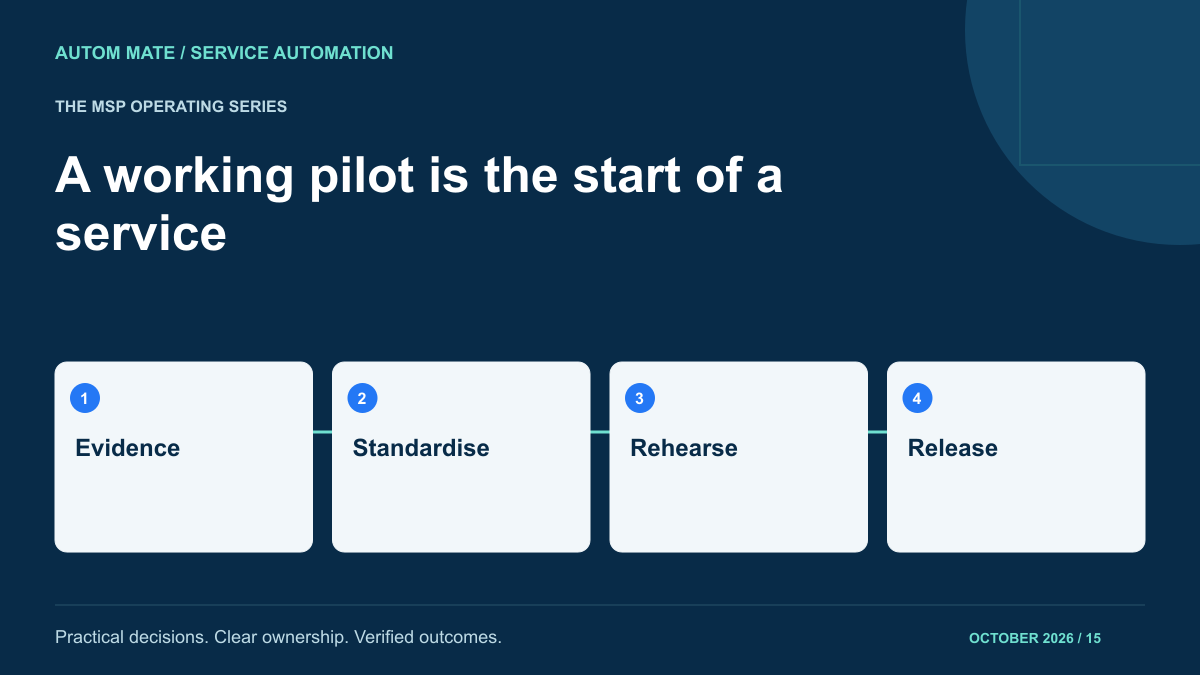
The pilot has completed the agreed task. The customer likes the result. The next customer has a similar problem. It is tempting to copy the workflow, change a few settings and declare a new managed service.
That jump hides several questions. Which parts of the pilot are reusable? Which parts depend on one customer’s data or one engineer’s knowledge? Who supports it when the original author is unavailable? A repeatable service needs answers before more customers depend on it.
The goal is not to make every pilot larger. It is to decide whether this particular automation can be offered with a clear scope, predictable operating responsibilities and evidence that it can be delivered again. The following release gates give an MSP a practical way to make that decision.
Preserve what the pilot actually proved
Start with a short evidence statement. Name the customer scenario, systems, tested conditions and completion check. Separate what was demonstrated from what was assumed or excluded. A successful account-provisioning action does not, by itself, prove a complete onboarding service.
Record the conditions that made the demonstration possible. Perhaps the customer supplied clean data manually, the engineer watched every run, or an application owner approved requests immediately. Those may be reasonable pilot arrangements, but they cannot silently become dependencies of a general service.
Keep a list of unresolved cases with owners. A pilot can be successful within its agreed boundary while still being unsuitable for broad release. That distinction protects the value of the pilot and keeps the release decision honest.
Separate the service core from customer choices
Choose a small service promise that can remain stable. An example might be preparing approved employee access across a defined set of applications, with exceptions routed to the designated owner. Then list the settings that may vary by customer: approved applications, request fields, approvers, operating windows and completion evidence.
The service should not require an untracked copy of the workflow for every variation. Equally, forcing every customer into identical rules can create an unsuitable service. The design task is to distinguish supported configuration from a genuinely different requirement.
Use the existing multi-customer MSP workflow design guide to structure that separation. Treat customer identifiers and access boundaries as part of the design, not as values to remember to replace after copying a pilot.
Use explicit release gates
Each gate should have a decision owner and evidence sufficient for someone outside the build team to review. The table below is a proposed working format. It does not impose a universal certification or claim that a particular platform makes these decisions automatically.
| Gate | Evidence to review | Reason to stop |
|---|---|---|
| Service scope | Clear request, inclusions, exclusions and completion definition | Sales and support describe different promises |
| Customer configuration | Documented settings and validated separation | Customer-specific values remain hidden in reusable logic |
| Operational support | Assigned monitoring, recovery and escalation responsibilities | Only the original engineer can operate it |
| Failure handling | Demonstrated interruption, retry and manual exception cases | A partial failure has no safe recovery path |
| Commercial fit | Known delivery activities and explicit charging assumptions | Unmeasured support work makes the offer impossible to explain |
| Controlled release | Initial customer cohort, observation plan and stop criteria | There is no owner for deciding whether expansion should pause |
Rehearse the service without its author
Ask another authorised operator to onboard a test customer using the prepared instructions. Have them identify the required inputs, validate permissions, run an accepted scenario and investigate a deliberately introduced failure. The test should use a safe environment and an agreed clean-up procedure.
Observe where they have to ask for undocumented knowledge. A missing explanation is a handover defect even when the underlying workflow is correct. Update the operating material and repeat the relevant part of the rehearsal after the correction.
Google’s SRE engagement guidance recommends defining service-level objectives before general availability and aligning monitoring with those objectives. That provides a useful release principle: support teams need a shared meaning of acceptable service before they inherit it. Google’s SRE engagement model describes that preparation.
Package the work around the workflow
The offering needs a service description, customer input checklist, responsibility table and operating procedures. Include how changes are requested, what support covers and how unresolved work is reported. A customer should understand the boundary without needing to inspect the workflow editor.
Use the managed automation service description checklist to make those details concrete. Keep promises aligned with the tested capability and available support. Avoid attaching an ambitious completion guarantee to a process whose critical application owner is outside your control.
Measure the activities surrounding delivery: initial configuration, routine observation, exception handling, maintenance and customer review. A reusable workflow can still require substantial operating effort. If that effort is unknown, record an assumption and an evidence plan instead of claiming a precise margin.
Expand only after the next customer teaches you something
Select an initial customer whose requirements fall within the stated scope, while still testing a meaningful configuration difference. The aim is to validate reuse, not to choose another identical demonstration that hides every difficult variation.
Agree who can pause expansion and which signals trigger that decision. Examples include unresolved cross-customer configuration issues, repeated manual repair or a support queue that the team cannot manage. A pause should preserve service for existing customers while the specific weakness is addressed.
Review the first delivery against the evidence statement and update the package. If every new customer demands a different operating model, you may have a valuable bespoke service rather than a standard one. Price and support it accordingly instead of concealing the difference.
When planning your next MSP service automation offering, bring the pilot result and the release-gate evidence together. The next commercial step should be a service your team can explain, operate and improve for the next customer.

