
A service desk sends a ticket to an engineering team. Engineering changes the status. The service desk receives it and sends another update back. Both systems are busy, but nobody has made progress on the customer’s issue.
Bidirectional ticket integration introduces more than a second arrow on a diagram. Each side can create events, apply local rules and change information while the other side is unavailable. Buyers need an acceptance test that shows which updates should travel, which should stop and what happens when the systems disagree.
Consider an illustrative integration between a customer-facing ITSM tool and an engineering ticket system. The test matrix below can be adapted to the products involved. It does not assume that their fields, status models or delivery guarantees are identical.
Decide who owns each piece of information
Begin with fields and actions rather than connector features. The service desk might own customer priority and external communication. Engineering might own development status and technical resolution notes. Some information can be copied; other information should remain private to the originating team.
Write the rule for each field in plain language. “Latest update wins” is a policy choice, not a neutral default. It can allow a delayed message to replace a deliberate correction. Where both systems can legitimately edit a value, define how the conflict is detected and who resolves it.
For status, use an explicit mapping with conditions. Engineering marking an issue as done may mean that a fix has been merged. The service desk may still need to arrange deployment, obtain customer confirmation or complete another task. Treating those two states as interchangeable can close work prematurely.
Run a test matrix with observable outcomes
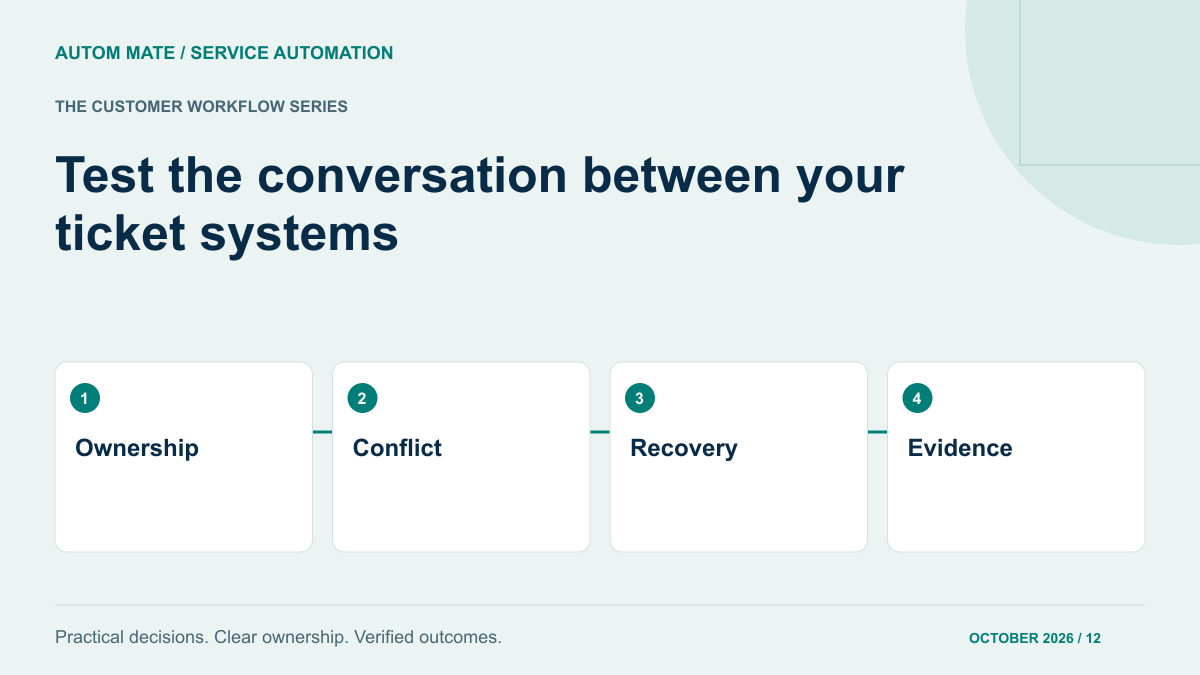
Use dedicated test records with known identifiers and an agreed clean-up procedure. For every test, record the starting state, submitted action, expected destination state and evidence in both systems. The examples below specify behaviours to agree with your delivery team, rather than universal product defaults.
| Test | Action | Expected evidence |
|---|---|---|
| Repeated delivery | Deliver the same source event twice | One intended business change; duplicate handling visible in the integration record |
| Echo loop | Copy an allowed status change to the other system | The resulting destination event does not bounce the same change indefinitely |
| Conflicting edit | Edit the same shared field in both systems | Agreed ownership rule or visible conflict queue; no silent arbitrary replacement |
| Private note | Add a note restricted to internal staff | No unintended customer-visible comment in the other system |
| Missing event | Interrupt delivery for a controlled interval | Gap is detected and eligible changes can be reconciled |
| Changed permission | Remove the integration account’s test permission | Clear failure, bounded attempts and an assigned recovery task |
| Out-of-order update | Deliver an older event after a newer one | The record does not regress contrary to the agreed version rule |
| Reopened work | Reopen a previously resolved ticket | The mapped relationship remains intact and both teams see the agreed state |
Separate a repeated event from a repeated business action
A transport identifier helps recognise another delivery of the same event. It does not always reveal that a person has submitted the same business request again with a new event identifier. Keep both concerns in the design: event handling for delivery and a stable relationship between the underlying tickets.
For a concrete vendor example, Atlassian documents a X-Atlassian-Webhook-Identifier header for Jira Cloud webhooks. It remains the same across retries and is unique within a tenant. Atlassian also notes that acknowledgement failures can lead to duplicate deliveries. Include the tenant when applying that identifier and verify the behaviour for the webhook mechanism you actually use. Atlassian’s Jira Cloud webhook documentation describes these details.
Avoid solving loops by discarding every event from the integration account. That may hide a legitimate change made as part of another service. Test how origin information, field ownership and the last applied source version work together. The acceptance evidence should show why an event was ignored, not simply that nothing happened.
Test the information boundary
Ticket descriptions, attachments and comments can contain more than status updates. Agree which content may cross the boundary and test those decisions using harmless sample data. A comment labelled internal in one system must not become public merely because its destination field has a different name.
Include customer and project boundaries in the tests. A ticket belonging to customer A must not attach to customer B’s engineering issue because both use the same visible reference. Test deleted or moved records as well: the service needs a deliberate response when a previously valid destination no longer exists.
Prove recovery after an interruption
Disconnecting and reconnecting a test endpoint should be part of acceptance. Once it returns, inspect the oldest pending changes, any permanently rejected items and any records that need comparison with the source. A quiet error queue does not prove that every expected event arrived.
Ask the operator to explain how they find a missing update without relying on a customer complaint. Then demonstrate replay or reconciliation using the agreed ordering and duplicate controls. For a detailed recovery worksheet, use the service desk recovery runbook. Keep the original incident references when repairing the affected records.
Turn the results into a buying decision
Record each test as passed, failed or not demonstrated, with an owner for the remaining work. “The connector supports two-way sync” is insufficient evidence for your specific permissions, fields and exceptions. Use the service integration evaluation guide to put the results alongside support and operating requirements.
Start with the connector or native integration you already have where it can meet those requirements. If there is a genuine gap, bring the test matrix and one representative ticket journey to an Autom Mate Enterprise integration discussion. The most useful demonstration is the one that proves how your difficult case will be handled.