
If your organisation already uses Microsoft Entra, an employee lifecycle project should start by examining the capabilities you have. A new orchestration tool needs to solve an identifiable service problem. It should not duplicate a native task simply because that task appears in an attractive demonstration.
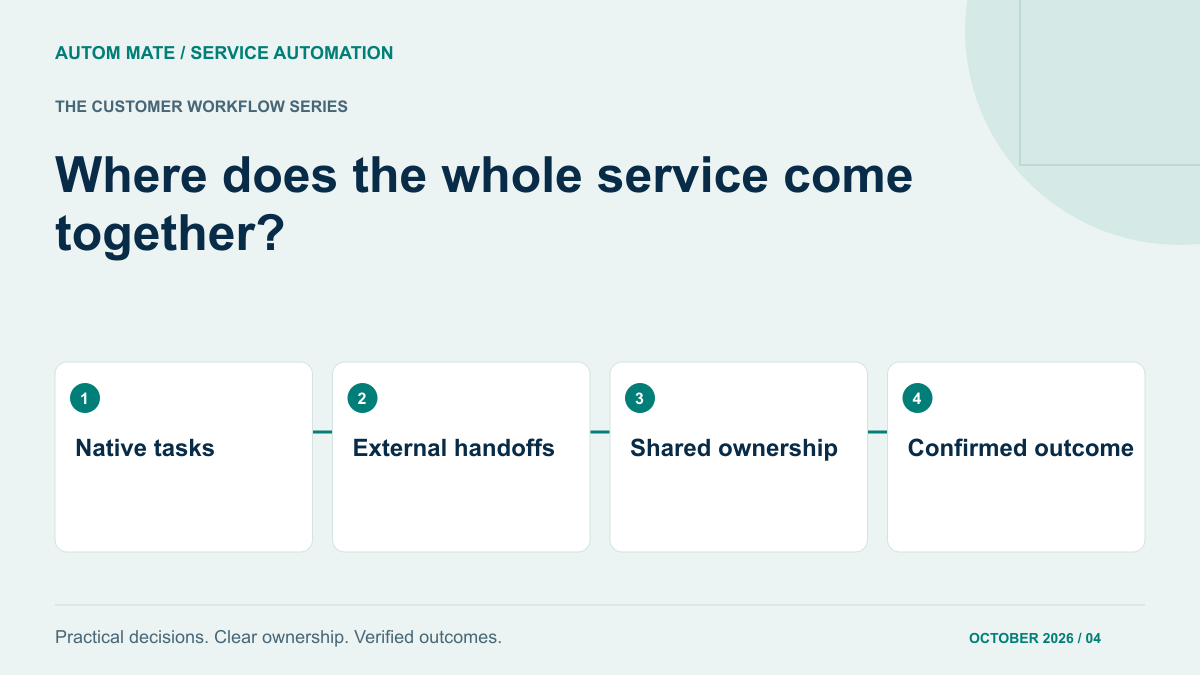
Microsoft Entra Lifecycle Workflows supports joiner, mover and leaver scenarios using tasks and execution conditions. It also supports extensions to external processes. The useful question is therefore where to place responsibility for the complete service when HR, identity, equipment, applications and the service desk all contribute.
This guide provides a decision framework for that boundary. It is not a product replacement checklist or a claim that one platform must own every step.
Establish the native baseline first
Review the Microsoft Lifecycle Workflows overview against the exact outcome you need. It describes lifecycle tasks, execution conditions and workflow history. Microsoft currently lists Entra ID Governance or Entra Suite licensing for this feature; confirm the entitlement and implementation requirements for your environment.
Write down the tasks the native service can already perform, those your organisation has configured and those that remain manual. Keep those three categories separate. An available capability is not necessarily deployed correctly, and an unconfigured feature is not automatically a product gap.
For a straightforward identity process, the existing native approach may be sufficient. Fixing source attributes or clarifying ownership can be more useful than adding another platform.
Map the whole employee outcome
Consider an illustrative starter who needs an account, application access, a laptop and confirmation from their manager that the required tools are ready. Identity tasks are one part of that outcome. Procurement, device delivery and application-owner decisions may have their own timelines and records.
Draw the service as a sequence of business states: request accepted, prerequisites checked, access prepared, equipment ready, exceptions resolved and readiness confirmed. Then place the system responsible for each action beneath the relevant state.
This exposes the coordination work. Somebody must know whether a pending laptop delivery blocks readiness, whether a rejected application request changes the agreed role package and who tells the manager that the planned start date is at risk.
Choose a clear owner for each boundary
| Boundary question | Keep or extend the native approach when | Evaluate wider orchestration when |
|---|---|---|
| Where does the authoritative event live? | The identity process receives reliable, governed lifecycle data | Several business systems disagree and reconciliation needs an owner |
| Which tasks complete the service? | Configured native tasks cover the agreed outcome | The outcome depends on separate application, device or service processes |
| Who investigates failure? | The operating team can trace and recover the full process | Support repeatedly crosses systems without a shared request reference |
| Who changes the process? | A single team owns the relevant rules and releases | Several service owners must coordinate changes and customer variations |
| How is completion demonstrated? | Available evidence satisfies the service definition | Each tool shows success while the employee outcome remains incomplete |
These are evaluation prompts rather than automatic purchasing rules. A well-designed native extension may solve a cross-system requirement. A separate orchestration layer may be appropriate when it creates clearer ownership and more reusable operating processes.
Understand what an extension reports as success
Microsoft documents custom task extensions using Azure Logic Apps. Its extension patterns include continuing after launch and waiting for a response. That distinction matters when a later task depends on an external outcome.
If an external process has only been started, the wider service should not assume that the work has completed. Define whether you need launch confirmation, a business-result callback or an independent check in the destination system.
For example, a successful dispatch to an equipment process does not prove that a laptop is ready. If equipment readiness is a required part of the employee service, preserve that pending state and its owner. Choose a completion signal that corresponds to the business fact you need.
Avoid two systems issuing the same change
Adding coordination should not leave two engines independently deciding to grant or remove the same entitlement. Establish which component issues each action, which component observes the result and which record represents the current request.
Use a shared correlation reference across boundaries where the systems support it. Keep enough execution history to distinguish a repeated message from a new business event. If an action times out, check what happened before repeating it.
Changes need the same discipline. If HR postpones a start, the coordination design must make the new state visible to the component that will activate access. Our start-date change guide explores those in-flight exceptions in more detail.
Test one complete service, including the handbacks
A useful pilot has a deliberately limited scope: one employee group, a defined set of applications and an agreed receiving team. Test the complete outcome and the failure boundaries, using approved test data.
- Remove a required source attribute and check that the case reaches the right owner before access is changed.
- Delay an external result and verify that “started” is not shown to the customer as “ready”.
- Return a failure after an earlier step succeeded and check that support can see both facts.
- Repeat an incoming event and confirm that it does not issue duplicate changes.
- Change the business request during execution and reconcile the resulting state explicitly.
Ask the support team to investigate one of these cases without the implementation engineer guiding each step. If they cannot locate the authoritative status, the service boundary needs further work.
Make the choice on operating fit
Compare the effort to configure, support and change the whole service. Include existing skills, permissions, licensing, monitoring and the cost of maintaining the handoffs. Avoid comparing a complete managed service with a single native task as though they were equivalent scopes.
Where native workflows cover the requirement and your team can operate them well, retain that investment. Where the unresolved problem spans several service domains, document that gap and evaluate options against it.
Autom Mate Enterprise Edition supports orchestration across business and IT applications. Bring one concrete lifecycle outcome and its unresolved handoffs to the discussion, so the evaluation stays focused on the service your employees actually need.