
Adding a human approval step to an AI-assisted service sounds straightforward. The difficult part arrives when twenty requests need review, the normal approver is unavailable and the requester expects an answer before the end of the day.
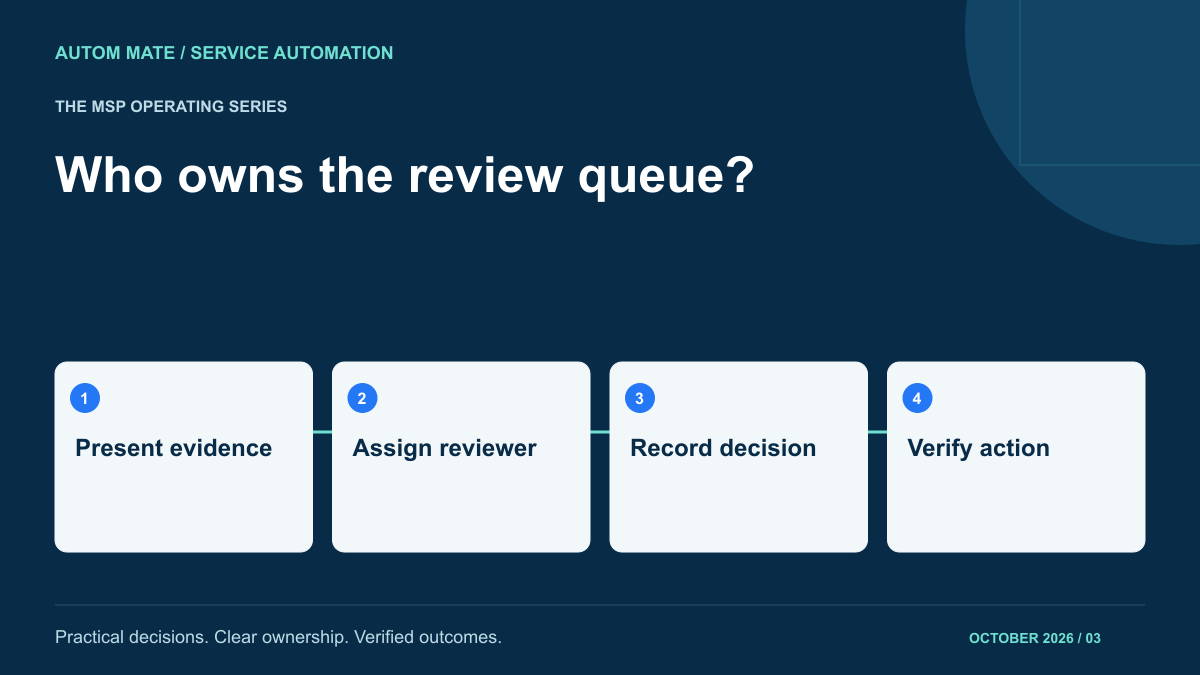
Human-in-the-loop AI needs an operating queue. Somebody must receive the work, understand the proposed action, make a decision within a useful time and leave enough evidence for the service to continue. A notification sent to an unattended mailbox does not provide that capability.
For an MSP, the queue also needs customer boundaries. A technician qualified to support one customer’s routine requests may not be authorised to approve another customer’s privileged access. Treat review as a defined service activity, with capacity and permissions of its own.
Describe the decision the reviewer is making
Begin with a concrete scenario: an AI assistant reads a software request and proposes an access package. The reviewer is not approving “the AI”. They are deciding whether a named person should receive a particular entitlement under the customer’s policy.
Show the original request, the proposed change, relevant source records and the reason the request needs review. Distinguish facts retrieved from systems from the model’s interpretation. If a required fact is missing, make that visible rather than presenting a plausible narrative as evidence.
For consequential actions, a reviewer should be able to inspect the underlying record. A polished summary can save reading time, but it should not be the only route to understanding the decision.
Give each queue a named operating model
| Queue decision | Example rule to agree | Failure it prevents |
|---|---|---|
| Eligibility | Only the customer’s nominated approver group may authorise this action | A support role is mistaken for business approval authority |
| Coverage | A named deputy handles requests when the primary owner is unavailable | Requests wait indefinitely in an absent person’s inbox |
| Expiry | An unanswered decision expires into a held state | Silence becomes accidental approval |
| Change handling | A material request change invalidates the earlier decision | An approval is reused for a different action |
| Escalation | A service owner resolves missing authority or conflicting information | Engineers improvise policy to clear the backlog |
| Execution check | The system rechecks decision validity before acting | A stale decision triggers a later unauthorised change |
These are design examples, not universal time limits or approval rules. Agree the actual policy with each customer and reflect it in configuration, reviewer instructions and acceptance tests.
Calculate the review workload before promising turnaround
Estimate the number of requests that reach review, the time needed for a proper decision and the available reviewer time. Separate that from the time the automation takes to run.
For an illustrative planning exercise, 30 reviews requiring four minutes each create two hours of review work. If the assigned owner has one hour available, a backlog is expected even when every system is functioning. The figures are deliberately hypothetical; replace them with observations from your own service.
Average effort alone is insufficient. A request burst before a payroll deadline or a customer holiday can change the waiting time. Measure arrivals by period, the age of the oldest item and the availability of appropriately authorised reviewers.
Do not solve a capacity problem by quietly broadening approval authority. Options include improving the evidence presented, narrowing the service scope, adjusting customer expectations or agreeing appropriate additional reviewers.
Make reject, revise and hold useful outcomes
An approve-or-reject interface can force reviewers to choose the nearest answer when the actual problem is missing information. Consider separate outcomes for rejection, request for clarification and temporary hold.
A rejection should record a reason that the requester can understand. A clarification should identify the specific missing input and its owner. A hold should explain what condition must change before the request can continue.
Keep the original proposal and the final decision linked. If the reviewer edits the requested action, check whether that edit is within their authority or requires a fresh approval. Record the action that was actually authorised, not only the fact that a button was clicked.
Test the queue under ordinary pressure
The most useful test cases resemble a difficult working day. Use test requests and authorised reviewers to confirm that:
- A request cannot be approved by somebody outside the correct customer and decision scope.
- A deputy can see the context required to act without receiving unnecessary customer data.
- Two reviewers cannot cause the same action to execute twice.
- An expired approval link does not revive a cancelled or changed request.
- A rejected proposal cannot continue through a separate retry path.
- A missing response produces a visible exception, with ownership, rather than a success status.
Also test whether reviewers can identify a confidently worded but unsupported proposal. The service should make missing evidence apparent. Treat a model’s confidence indicator as one input to investigate, not a substitute for authorisation or a guarantee that a decision is correct.
Review the quality of decisions as well as queue speed
Fast approvals can hide weak review. Alongside waiting time and backlog, examine samples of decisions that were later reversed, requests returned for missing evidence and cases where an action differed from what the reviewer approved.
Discuss patterns with reviewers without turning the exercise into a target to approve more requests. Repeated clarification requests may indicate poor intake design. Repeated reversals may indicate ambiguous policy or misleading context. Different problems need different fixes.
The voluntary NIST AI RMF Playbook provides a broader structure for considering AI governance and measurement. The queue design here is a practical operating pattern; implementing it does not establish compliance with a standard.
Connect review to the delivered service
The AI action and approval matrix helps decide which actions need oversight. The review queue determines whether that oversight can function during real service delivery.
Choose one approval-heavy workflow and inspect its oldest unresolved items. Identify whether the constraint is authority, evidence, capacity or execution. That gives a specific starting point for designing a governed service with Autom Mate for MSPs.