
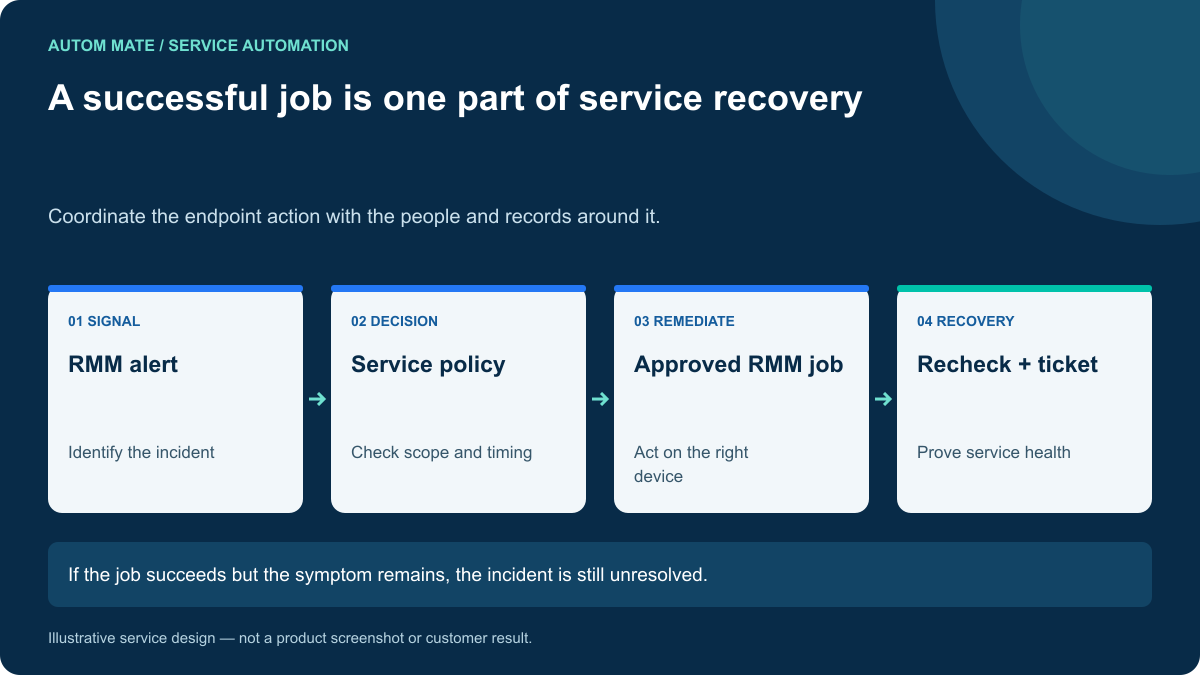
RMM automation performs work on managed endpoints; service orchestration coordinates that work with customer context, approval, verification and support ownership. They can complement each other. A capable endpoint tool does not need to be replaced merely because the surrounding service has manual handoffs.
The practical question is where responsibility ends. Is success a script exit code, a healthy application, a resolved incident or confirmation from the affected business owner? Write that definition before connecting an alert to an action.
Keep endpoint execution in its supported tool
Datto RMM documents quick jobs for immediate component deployment and scheduled jobs for running components against selected devices and scopes. Use the platform’s supported execution and job-result mechanisms where they fit the service.
A wider workflow can decide whether a job should run, connect it to a service request and check what happened afterwards. That coordination should respect the RMM’s permissions and operating controls rather than bypass them with a second unmanaged execution route.
A boundary map for one remediation service
| Responsibility | Typical owner | Completion evidence |
|---|---|---|
| Observe endpoint condition | RMM monitoring | Timestamped signal and device reference. |
| Resolve customer and service | Maintained service mapping | Unambiguous customer and affected service. |
| Authorize intervention | Customer policy and change process | Permitted action, scope and timing. |
| Run the action | Supported RMM job | Job reference and execution result. |
| Confirm recovery | Defined health check | Expected state restored or exception retained. |
| Close the support loop | Service desk | Accurate incident outcome and follow-up. |
The names of the products may differ across customers. The responsibilities should remain clear enough that an operator knows which system to consult when one part fails.
Example: a stopped application service
Consider a fictional customer with a monitored application service that can be restarted under a pre-approved operating policy. The example does not establish that every service restart is low risk or suitable for unattended execution.
The workflow receives the alert, resolves the customer and device, and checks whether the condition is still present. It confirms that the device and service are within scope and that no maintenance or change restriction blocks the intervention.
It then invokes the approved RMM component and records the job identifier. After completion, it checks the defined health condition over an agreed observation window. A successful restart command with a service that immediately stops again is an unresolved incident.
The service desk record should show the observed condition, action, job result and recovery evidence. If health remains poor, escalation should include those facts so a technician does not repeat the same investigation.
Avoid alert-driven action loops
Repeated alerts can arrive while an earlier remediation is still running. Connect them to the same incident or work item where appropriate. Define limits on repeated intervention and a route to a person when the service is unstable.
Do not let a monitoring loop restart a critical component indefinitely. A recurring symptom can indicate a problem that needs diagnosis. The workflow should recognize when it has exhausted its approved recovery attempts and preserve the evidence for escalation.
Likewise, a stale alert should not trigger work after the condition has already recovered. Rechecking current state helps avoid unnecessary disruption.
Where AI can help
An AI component may help summarize the incident, classify the symptom or retrieve an approved runbook. The permitted action still needs to come from the service policy and current context.
Do not promote arbitrary instructions from a ticket, log or model response into privileged endpoint commands. If the incident falls outside the known service, use the output to support a technician’s investigation rather than treating it as an execution authorization.
Test recovery, not just invocation
- An alert for the wrong customer cannot invoke a job.
- A recovered condition produces no unnecessary restart.
- A duplicate alert does not start a conflicting parallel action.
- A successful job with a failed health check remains unresolved.
- A failed ticket update does not repeat the endpoint action.
- A recurring fault reaches the designated escalation owner.
Measure verified recovery time, repeated incidents, manual effort and unnecessary interventions. More automated jobs can mean more productivity, but can also mean a noisy loop. The outcome tells the difference.
Connect remediation to your service workflow
Autom Mate can be evaluated for coordinating a configured remediation service across monitoring, service desk and execution systems. Specific RMM actions and verification signals must be confirmed for the target environment.
Explore infrastructure automation and the request-to-outcome service desk guide. Bring one recurring alert and its approved runbook to map the complete recovery service.