
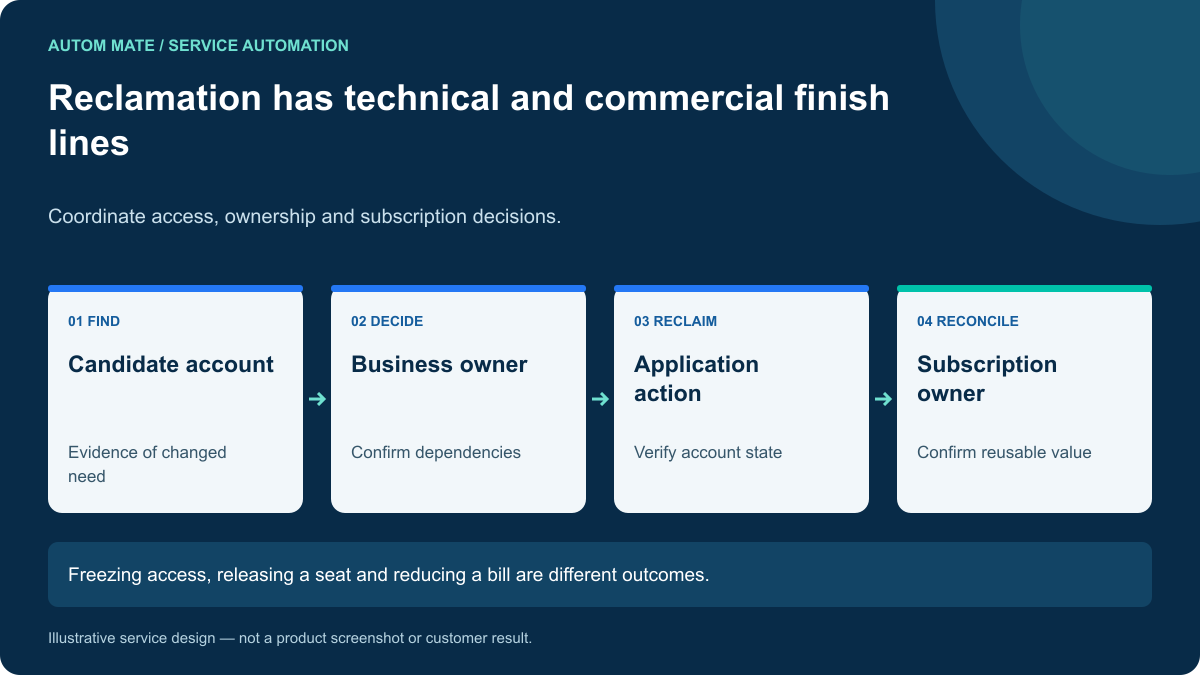
SaaS license management needs a reclamation workflow that considers access, business ownership, data dependencies and the commercial agreement together. An unused-looking account is a candidate for review. It is not automatic permission to delete data, transfer records or reduce a subscription.
The most useful automation connects those decisions so that a business-approved change reaches the application and its financial consequence is recorded accurately.
Start with candidates, not automatic removals
Candidate signals might include a confirmed departure, a role change, duplicate accounts or low observed activity. Each signal has limitations. Infrequent use can still support an important business process, and activity data may omit background integrations or noninteractive access.
Gather the evidence and present it to the appropriate owner. A department manager may confirm whether a person still needs an application; an application administrator may understand record ownership and scheduled tasks; a commercial owner may know the subscription’s change conditions.
Those responsibilities can belong to different people. The workflow should make the handoffs explicit instead of assuming that one approval covers all consequences.
Define the states you need to distinguish
| State | Meaning | What it does not prove |
|---|---|---|
| Review candidate | Evidence suggests an account may no longer be needed. | Removal is authorized. |
| Access restricted | The supported restriction has been applied. | A paid seat has been released. |
| Ownership resolved | Required records or processes have an approved owner. | All retention obligations are complete. |
| Seat available | The application shows capacity available for reuse. | The subscription bill has decreased. |
| Commercial change confirmed | The agreement or charge reflects the intended change. | Every earlier technical step was performed correctly. |
This model prevents a dashboard from reporting the same account as a completed saving at several different stages.
Salesforce illustrates why the distinctions matter
Salesforce’s user-freezing documentation explains that freezing blocks account access but does not release the user license; deactivation is required to make that license available. Its deactivation considerations also describe dependencies that may need attention.
The general design lesson is to inspect the specific application’s semantics. Do not use “disable,” “freeze,” “deactivate” and “delete” interchangeably in a cross-application workflow.
A proposed reclamation service
Imagine a fictional employee changing responsibilities and no longer needing a sales application role. A scheduled review identifies the account, but the employee owns records and a business process still references them.
- Collect the candidate evidence. Record the source, observation period and reason for review.
- Confirm business need. Obtain a current decision from the appropriate owner.
- Inspect dependencies. Check ownership, integrations and other application-specific conditions.
- Apply the approved sequence. Restrict, transfer or deactivate only as authorized for that application.
- Verify technical state. Record which account changes completed and whether the seat is available.
- Reconcile commercial value. Confirm reuse or an actual quantity/charge change with the subscription owner.
If a dependency blocks deactivation, preserve that state with an owner. Do not mark the complete request successful because the initial access restriction worked.
Respect the source that owns access
Some applications receive accounts and roles through an identity provisioning system. A direct application edit may later be overwritten by that source. Establish the owning system before deciding where the removal should happen.
Similarly, reactivating an account as a recovery step may not restore every related setting. Use the application’s supported recovery model and document irreversible operations before including them in automation.
For an MSP, keep each customer’s tenant, owner and commercial agreement attached to the request. A shared service definition can support different review periods and application policies without treating all customers as one subscription.
Measure both quality and value
Track reviewed candidates, approved changes, blocked dependencies, verified available seats and confirmed commercial changes. Also measure wrongful removals or restoration requests: savings that repeatedly disrupt users are not a healthy service outcome.
Use actual paid unit costs and contractual timing for financial calculations. A public list price multiplied by inactive accounts is an opportunity estimate, not realized savings.
For a recurring service, review the time spent by application owners and operators. If every candidate requires extensive investigation, improving account ownership data may be a better next investment than increasing the automation rate.
Connect your first application
Autom Mate can coordinate the review and fulfillment steps across configured service desk, identity and application connections. Select one application with a clear owner and an understood reclamation process for the initial scope.
See our employee offboarding guide for the wider lifecycle. Bring one blocked license-reclamation case; we can map the decisions and dependencies that prevent it from becoming a completed, measurable outcome.